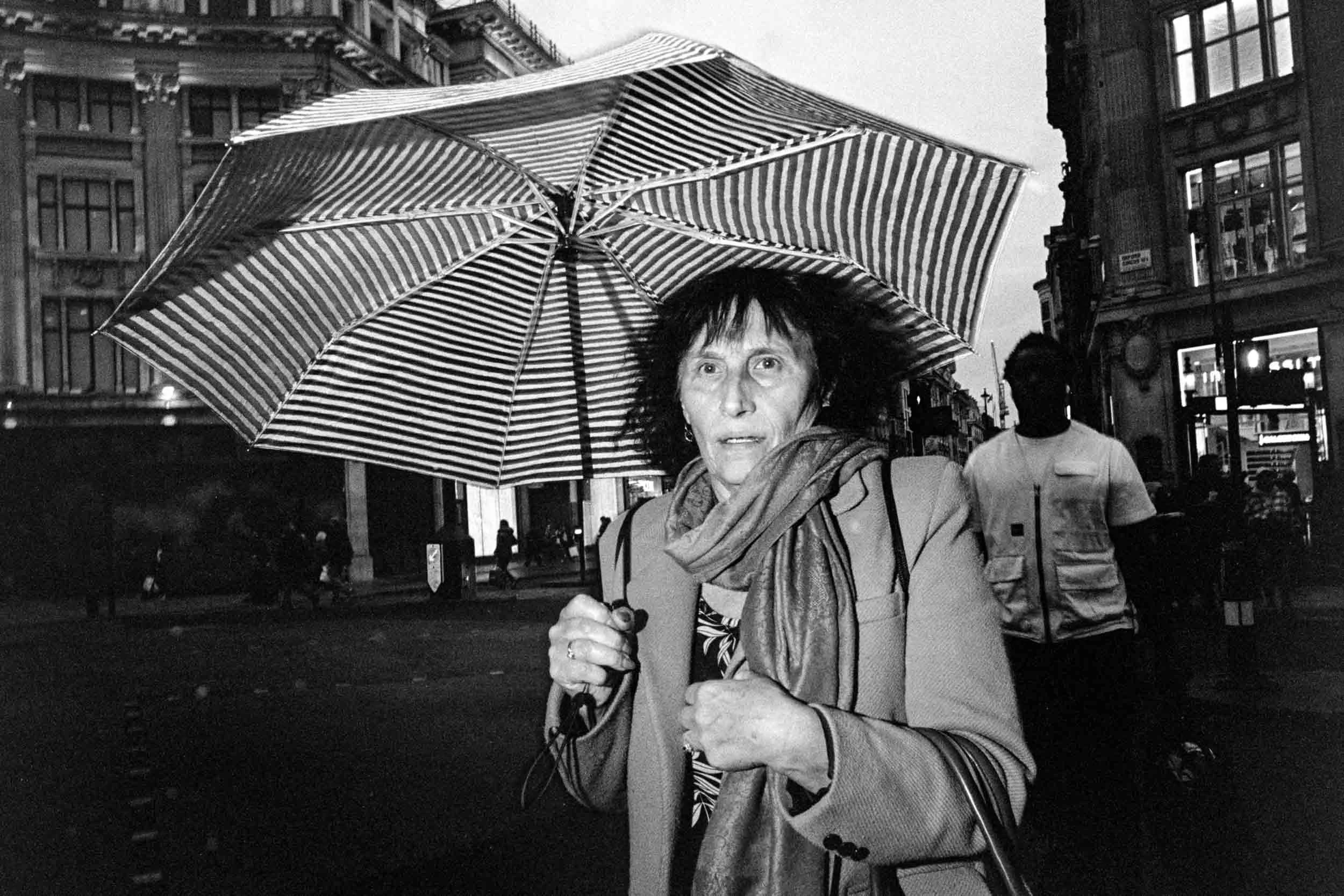
Robert Watson. Woman under umbrella, London. 2026
Robert Capa’s quote…and what does it mean to me?
“If your pictures aren’t good enough, you’re not close enough.”
Robert Capa
I first heard this quote decades ago and it occupies room in my head to this day. It’s not a mantra when I’m on the streets, my mind is too full of everything else - all the thoughts - that a street photographer who is completely focused in the search for meaningful pictures has going on in their head. I have to be completely focused.
To most, the initial interpretation that jumps to mind is getting physically close. And it’s valid. However, to me, it holds far more than that.
For most photographers, getting close will mean filling the frame, creating impact or producing a more intimate portrait. For me, it also has other meanings. It’s about putting the viewer inside the situation. Being physically close enough that they feel part of the moment. Importantly, it’s also about emotional closeness. Not only to the subject but also to the situation I found them in.
A good example of this is from one of my favourite photographs. Taken in Blackpool in the height of summer in 2026. It shows two people being pushed along in wheelchairs amongst others. It’s close but not intrusively so. Close enough to see the expressions on all the subjects faces. No one looks particularly happy. The photograph tells a story yet leaves questions unanswered. To me, something that all art should do.
‘A picture is a secret about a secret, the more it tells you, the less you know.’
Diane Arbus.
There are also times when getting close was too much. Not for me but for the subject of my photograph. One particular instance in London, there was an older lady standing outside a cafe. I was shooting with a friend so my bravado was overflowing (absolutely not a good thing). I got in close, took the photograph and instantly regretted it. She wasn’t happy. The last thing that I want to do is upset someone. The picture wasn’t any good either. A double whammy of regret. It taught me a good lesson. I realised I had crossed a line and from then onwards I took a step back. Luckily, the mistake served me well. I guess though if you’re not learning, you’re not trying hard enough.
I have also recently started using flash when the light is fading where the ‘getting close’ thoughts are screaming at me, not necessarily in a good way, as I walk around. Photographing exclusively on film imposes limitations on when I have to stop shooting. Flash overcomes these shortcomings imposed by the lack of light and has made my street photography process both easier and far far more ‘interesting’. For me flash is only really useful at close quarters. Close enough that it can feel intrusive. In busy streets like there are in London or New York, a pop of flash followed by a quick thank you can diffuse most situations that might arise. In a down at heel place like Northern seaside town Blackpool where I spend a lot of time, it can lead to confrontation. You just have to pick your battles. My anxiety levels can be sky high yet I would rather take one meaningful picture no matter how scary it might be for me to execute than shoot numerous rolls of film to feel like I have had a productive day of street photography.
In what way has it made things easier for me?
Firstly, using flash at close proximity to someone at dusk or at night, you reduce the picture to being about the subject rather than the scene that they are in. All I need to look for is an interesting person. I’m not having to look at the complete scene that they are a part of. No layers are necessary. There are still occasions though when I’m developing the film and making contact sheets that I notice background details that elevate the picture from just another snapshot to a great photograph. It’s usually someone lurking faintly in the background who has noticed me lifting the camera to compose the frame when the main subject hasn’t. In a rather counter intuitive way, someone I’m in very close proximity to and is the main subject of my picture is less likely to notice me prior to the flash going off.
Secondly, the very steep learning curve to climb and the levels of anxiety that are present when using flash at close quarters to get good photographs have taught me how to be much more stealthy on the streets. When applied to my work during daylight hours, these lessons have calmed my nerves immeasurably. Allowing me to think more about the situations I see developing, and the pictures I take rather than battling anxieties.
With all these thoughts and examples, the biggest problem to overcome is simply finding the courage to get close enough. Close to someone and taking their picture candidly using flash or not.
There is only one way to overcome this fear and build up courage and that is practice, practice, practice…and realising that failure is all part of the learning curve… and that there may be confrontation. I don’t mean over a weekend or a year. I mean over years and years. Decades. My first street photographs were of the backs of people. I thought they were great at the time. Heavens, I even took them into a gallery and proudly showed them off. Looking back, I realise they were a part of this learning curve. Bruce Gilden who, next to Mark Cohen, is the master of getting close, didn’t walk out of his front door on day one of his career as a street photographer and make incredible images straight away. That’s all part of the game of street photography.
And, of course, the ability to get in close or copying those who have made a career out of it doesn’t automatically mean the picture will be great. Street photography has too many variables.
This leads back to what does getting close mean to me?
It has two meanings. To a point, it has nothing to do with how physically close you are to a subject. There is the bigger, more time consuming and photographically ‘dry’ time with the challenge to get emotionally close to a subject and their surroundings. To be there taking pictures (as close as they might be), candidly and to be accepted by the community you’re working in. This takes lots and lots of time. Famously, Bruce Gilden has done this with The Yakusa (an organised crime syndicate) of Japan as well as various biker gangs and prostitute networks. But most notably to me, Bruce Davidson managed it on the subways of New York in the 80’s and 90’s. As a street photographer, Davidson’s book ‘Subway’ is a monumental work where he put his life on the line in his quest for closeness for the historic photography that he made.
I live in the North West of England and Blackpool to me is a town that I want to get my teeth into. I find it fascinating. There is such a contrast between its daily visitors who walk up and down the golden mile and the locals who make a living in the town. Street photography there has changed dramatically since the seaside days of Martin Parr. It’s a little more edgy for want of a better word now. I’ve been a regular visitor there over the past couple of years and I’m slowly getting a feel for the place. Finding the courage to get closer and closer in my attempt to take meaningful pictures. My thoughts are to get a portfolio of photographs that I can show rather than just diving into the backstreets, camera in hand. I need some photographic ammunition before getting ‘close’.
Which is more scary…getting physically close or doing the legwork so to be able to get emotionally close to a community? In Blackpool’s case they both feel equally as challenging as the other. Getting close is not only about courage and proximity, it’s about understanding, trust and ultimately putting yourself inside a situation.
Still, whatever your definition of the art of getting close is, there is a fear that needs to be overcome. Getting over this fear will bring meaning to the work and to a project. And this meaning will bear more weight than the finished photography itself.
