Why street photography?
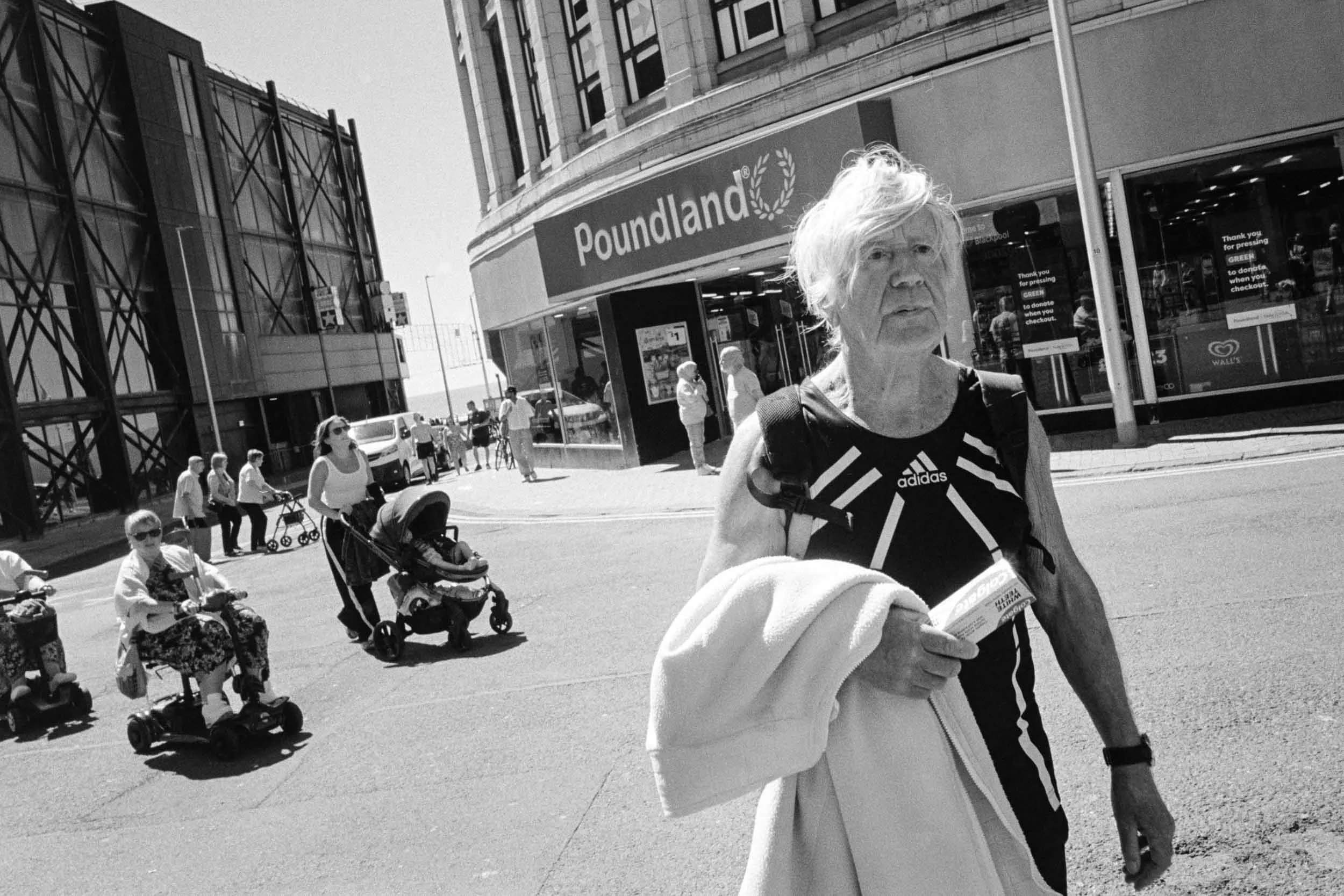
Blackpool, England, 2025
One of the most penetrating things that the artist Andy Warhol once said was, "If you lock the doors of a department store for a hundred years, when you open them up again, it will be a museum." In other words, all those objects of everyday use, our toasters and sneakers, our tights and perfumes, will eventually speak to our successes of an era we don't even notice ourselves living in, but which will seem as distinctive, archaic, and interesting to them as the civilisations of the Phoenicians or the Habsburgs do to us. Today's cotton and polyamide duvet covers, shower curtains, and Tupperware boxes are still indiscernible objects of record and pregnant complex testaments to an as yet unnamed historical moment.
As imperceptibly as a continent moving millimetre by millimetre across an ocean, time is bearing us along with our motley baggage of scented candles and lava lamps, coat hangers and picture frames, rolling suitcases and hair dryers over to an unknown world. However, Warhol wasn't just trying to draw our attention to how silently eras shift. He was also making a point about reverence and its sharp and unfortunate misallocation. When we step into museums like the Louvre or the Metropolitan Museum of Art, the Rijksmuseum or the Hermitage, we are almost always in a mood of immense and heightened respect. We whisper as if in the presence of deities. We take in the captions in illuminated cabinets. A bronze vessel from the Shang dynasty. A comb from the late period. A snuff box from the reign of Louis the 14th. All as if we were reading lines from a holy text. And yet looked at from another angle, what are we really looking at as we make our way around these august halls other than the contents of a giant old shopping catalog? Warhol had nothing against shopping catalogues. In fact, he once described the one from Macy's as the greatest work of literature of the 20th century, decisively surpassing an interest in humanity the novels of Thomas Man or Marcel Proust.
What angered him and inspired much of his art, was how disrespectful we tend to be of the everyday, in contrast to how differentially awed we are of anything that is historically endorsed and heralded. He yearned to help us to wake up to the overlooked beauty, grandeur, subtlety, and charm of grocery stores and burger bars, airplane galleys and hair salons, inflatable bathing pools and deck chairs. He didn't want us to wait a hundred years before appreciating our lives. He didn't want us to be on our deathbeds before we ever noticed how strange and fascinating everything happens to be. He thought it a crime that we might walk through the world paying so much attention to a Celadon glazed ceramic vase from the Song Dynasty and so little to a box of cheese straws from Gristedes. His art was a distinctive passionate attempt to accelerate the process of cultural appreciation and love.
All this is more than a point about aesthetics. It's an invitation to a revolution in living. We are in a constant struggle to remain aware of the miraculousness of things. The pencil we're using and the trousers we're wearing right now are wholly peculiar and entirely mesmerising. The packet of biscuits in the kitchen is a minor work of art. The chat you've just had with a friend is from a certain angle literature. How you would notice it all if you were going to die tomorrow or if you'd returned from the year 4509 or if you were 5 years old.
None of these may be possible or desired options for us, but nor do they need to be. We can use the thought that someone from a century hence will find us quite rightly gripping in order to value ourselves a little more fairly in the here and now. We should imagine that we are already living in a museum. The largest and most interesting museum that's ever existed around which are scattered an infinite number of invisible captions as important as any to be found in Versailles waiting for us to wake up and read them. We need to keep rehearsing the message because of how tightly despair and habit have us in their grip. Right now is extraordinary. Today is unique. Everything is exceptional. All should be constant. You contain galaxies. We should not have to wait till our world has been lost to see and derive sustenance from its beauty.
Alain De Botton.
The School of Life.
The question I’m most commonly asked after taking someone’s picture or by viewers of my street photography on a gallery wall is why bother taking pictures of things that are happening today? It’s just not interesting.
De Botton, in his inimitable way, in the above transcript of a video from his YouTube channel answers this question in a breadth and depth that leaves absolutely no doubt as to why it’s important to praise, wonder at and celebrate the blandness of now.
